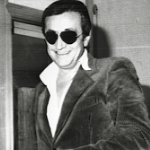
When Italo Toni arrived in Beirut together with his partner and collaborator Graziella De Palo to document the living conditions of the Palestinian refugees and the political and military situation in that area, he was 50 years old. The new trip to Lebanon had been thoroughly prepared and he went as editor of the Diaries, a chain of regional newspapers that the publisher Parretti was launching in Italy at that time. Profoundly knowledgeable of the problems of the Middle East, Toni had numerous collaborations with newspapers such as Il Ponte, L’Astrolabio, Aut and Mensile. He was the first to tell the world in Paris Match in 1968 about the existence of the first training camps of Palestinian guerrillas. Italo was born in Sassoferrato, in the province of Ancona, in 1930. He was from a family of metal workers well known locally. However, Toni became an elementary school teacher and was very active in the local branch of the Socialist Party. After a few years he left teaching and moved to Rome. Here he began his journalism career collaborating with La Conquista, a periodical of the Socialist Youth Federation.
(Update by Loredana Colace, Raffaella Della Morte and Marta Ramadori – 3 May 2020)
The judicial investigations did not lead to the identification of the culprits. The bodies of Graziella De Palo and Italo Toni have never been found. Even today, family members have doubts about the reconstruction of the events according to which they left the hotel that day and never returned.
- 1980 – The Italian Embassy takes up the matter on September 15, at the request of the De Palo family. At the beginning of October, the Italian Foreign Ministry opens a dossier. The investigation is entrusted to the head of the SISMI centre in Beirut, Colonel Stefano Giovannone, and not to the Italian ambassador to Beirut, Stefano d’Andrea. One of the main individuals dealing with the family members was Colonel Giovannone, who had an elusive and contradictory behaviour and at the trial was the first to invoke official secret on relations with the PLO. Giovannone spread all kinds of information: first he communicated that Graziella was alive and was kept segregated under the surveillance of Arab women, then that there were no reasons to consider her still alive. In one of her articles Graziella De Palo without mentioning the name, had outlined the identity of the Middle East middle man of the Italian armaments industries.
- 1981 – On April 18th the De Palo family is received in Damascus by Yasser Arafat. The head of the PLO promises the release of Graziella. On the 12th June, the Christian Maronite militia denied responsibility for the kidnapping, which took place in West Beirut, a territory under the strict control of the PLO.
- 1982 – On January 14th , the Italian government opens an investigation, entrusting it to a deputy of the Rome public prosecutor.
- 1983 – On January 24th the De Palo family returns to Lebanon, accompanied by a delegation of Italian journalists. Abu Ayad, head of the PLO secret service, who had invited her family, declares that Graziella is still alive and in the hands of the Christian Maronite Phalangists. But this trip does not produce any concrete results for the investigation.
- 1984 – Prime Minister Bettino Craxi classifies the affair as a state secret. The names of Graziella and Italo are even removed from the lists of the relevant international official annals, which list journalists who have died doing their job.
- 1985 – The titular judge of the investigation in Italy asks for an international arrest warrant against George Habbash, a point of reference for all the radical opposition groups of the PLO and a member of the Popular Front for the Liberation of Palestine PFLP, suspected of being the instigator of the kidnapping and killing of the two journalists. The judge also asked for the indictment of Colonel Giovannone and General Santovito, director of SISMI, for aiding and abetting. The investigative context is that of the so-called “Lodo Moro”, an agreement between the then leader of the PLO, Yasser Arafat and the Italian government, whereby Italy was to be free from the attacks of the Palestinians who were, however, free to use Italy as a base and place of transit of men, weapons and explosives.
- 1986 – The investigation into the disappearance of Italo and Graziella ends without anyone found guilty: George Habbash is acquitted due to insufficient evidence and, because of their death, the men of the SISMI who allegedly hindered the search for truth are also acquitted.
- 2006 – In January, the case returns to public attention on the twenty-fifth anniversary of their deaths, thanks to the creation of the website toni-depalo.it and an episode of the Rai TV program Who has seen it
- 2009 – Senator Francesco Rutelli invites Graziella’s brother, Giancarlo De Palo, to a hearing at Copasir (the parliamentary security committee. The family, in fact, in the previous months, had presented a formal request to the then Prime Minister Silvio Berlusconi to declassify the state secret status affixed in 1984. Rutelli, with a letter signed unanimously by all the members of the Committee, asks and obtains from Berlusconi the declassification and release of about a thousand documents on the tragic death in the possession of the SISMI (which in the meantime became AISE). The released documents are those containing material not directly related to the agreements entered into secretly by SISMI with the Organization for the Liberation of Palestine and which constitute the so-called Lodo Moro. This is the only case in Italian history that has seen the implementation of the new laws regarding the treatment of state secrets introduced by the last government of Romano Prodi with law no. 124, promoted by COPASIR itself.
- 2014 – On August 28th the secret classification is removed but only in relation to what does not concern relations between Italy and Palestinian organizations (Lodo Moro).
- 2017 – At the public conference promoted by Ossigeno, in May of that year, Graziella’s mother and cousin said: “We are not asking who the culprits are, because we know how things transpired . But we would like at least to have the remains of Graziella and Italo ”.
- 2019 – In December, accepting the request of family members and colleagues, the Rome Public Prosecutor’s Office reopens the investigation, thanks to an anonymous witness according to which Graziella De Palo was also investigating the Bologna massacre, which took place on the 2nd August 1980, one month exactly before her disappearance. According to her brother Giancarlo, the journalist was following the “Lebanese trail”.
In the request filed with the Public Prosecutor’s Office, connections are seen between some acts declassified in August 2014 and the arrest in November 1979 of Abu Azeh Saleh, head of the PFLP (Popular Front for the Liberation of Palestine) arrested in Bologna for being the guarantor of the transport of two surface-to-air missiles destined for the Palestinians.